The short answer
A certificate of authenticity should include:
- Who issues it and in what role: the artist, a studio or a gallery.
- The work: title, creator, year, medium and dimensions.
- A short statement from the issuer that the details are accurate.
- A signature and the date it was issued.
- Strongly recommended: a photo of the work, the edition number if there is one, and a unique certificate number.
That is the whole list for most works. The rest of this guide explains each item, shows four filled examples and covers what to leave off. When you are ready, you can fill in a certificate online with exactly these fields.
What a certificate of authenticity is
A certificate of authenticity is a document, usually signed by the artist or the person who issues it, that identifies a specific work and records the issuer's statement about it. It normally travels with the work when it is sold, and the issuer keeps a copy.
Two parts do the work: the identification (enough detail and a photo that nobody could mistake which piece it describes) and the statement (who is speaking, and what they confirm). Everything else is there to make those two parts clearer.
The essentials
These are the details buyers, galleries and marketplaces look for first. Our editor asks for them in the same order.
| Detail | Why it matters | In the editor |
|---|---|---|
| Issuer name and role | Says who stands behind the statement: artist, studio or gallery. | Required |
| Title or description | Names the work. “Untitled” plus a short description is fine. | Required |
| Statement | The issuer’s own words that the details are accurate. | Required (starting wording given) |
| Creator | The artist or maker, when that is not the issuer, as with a studio or gallery. | Encouraged |
| Year | When the work was finished. | Encouraged |
| Medium or materials | Tells similar works apart: “Wood-fired stoneware with natural ash glaze”. | Encouraged |
| Dimensions | With the unit; image and sheet for prints and photographs. | Encouraged |
| Signature and issue date | A handwritten signature on the printed line is the usual choice. | Blank line to sign by default |
Details worth adding
- A photo of the work. The strongest link between the paper and the piece, especially for originals and objects. Use a clear, uncropped image of the whole work.
- Edition. For prints and casts: the number and the total, such as 7/25, or AP for an artist proof.
- Certificate number. A unique reference for the certificate itself, such as
COA-2026-0418. It is different from the edition number. - Series when the work belongs to a named body of work, such as “Harbor Light”.
- Care notes for objects and works on paper: “Food safe. Hand wash only. Small variations in glaze are part of the firing.”
- Website or contact so a future owner can reach you. An optional QR code can open your own page for the work.
- Your logo if you issue as a studio or gallery.
What to leave off
- The price. It belongs on the invoice or receipt. The certificate may outlive the sale.
- The buyer’s name, unless they ask. A certificate without it can pass to the next owner; keep buyer details in your own records.
- Anything you cannot stand behind: appraisals, guesses about value, or words like “guaranteed” and “verified”.
- Long biographies. A line about the work is plenty; your CV can go in the sale pack.
Examples for four kinds of work
The same checklist fits very different work. Each example below is a fictional certificate made with this site. Open one to start from it, then replace the details with your own before you download.
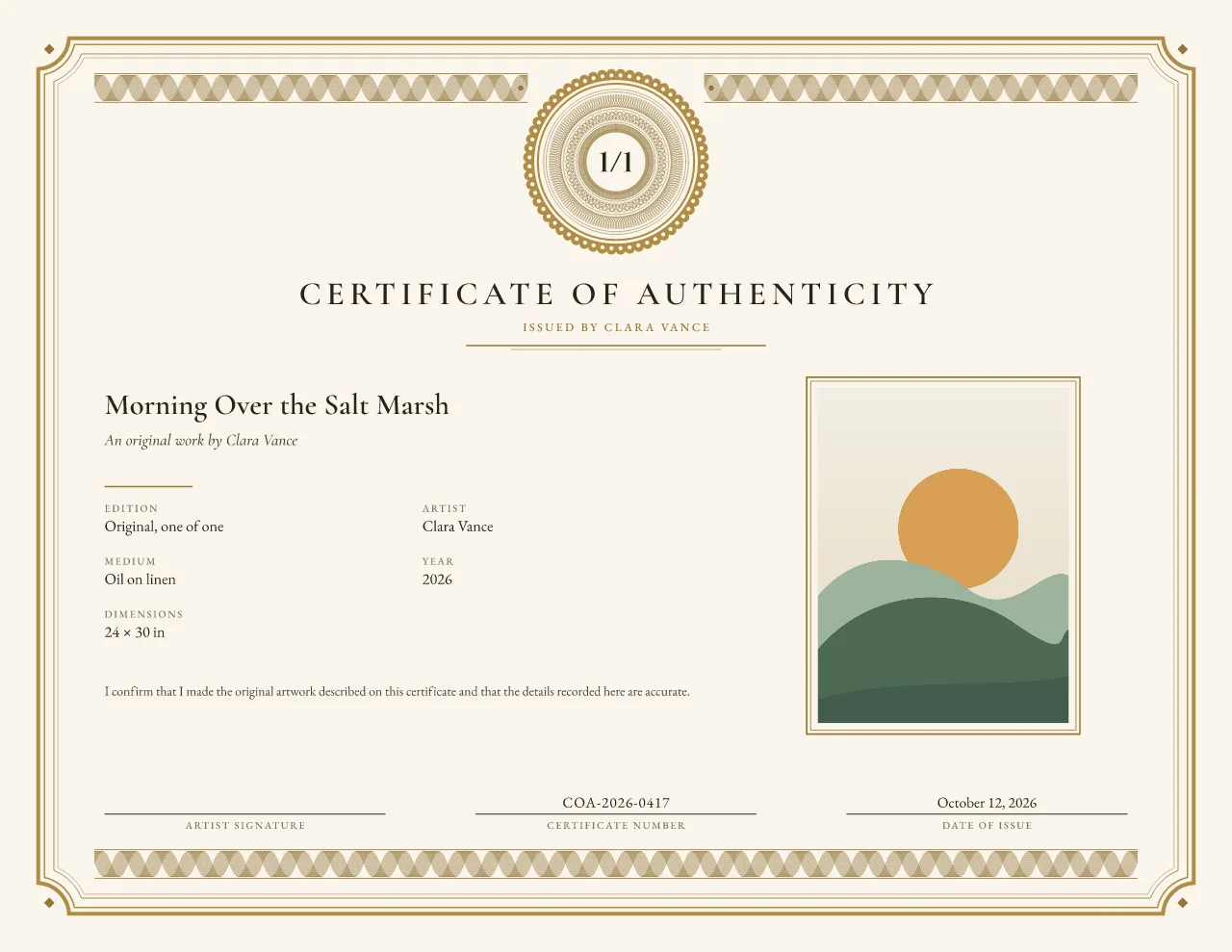
Edition Rosette design
Original painting
An original. See certificates for artwork.
- Issued by
- Clara Vance
- Work
- Morning Over the Salt Marsh
- Medium
- Oil on linen
- Size
- 24 × 30 in
- Edition
- Original, one of one
- Certificate no.
- COA-2026-0417
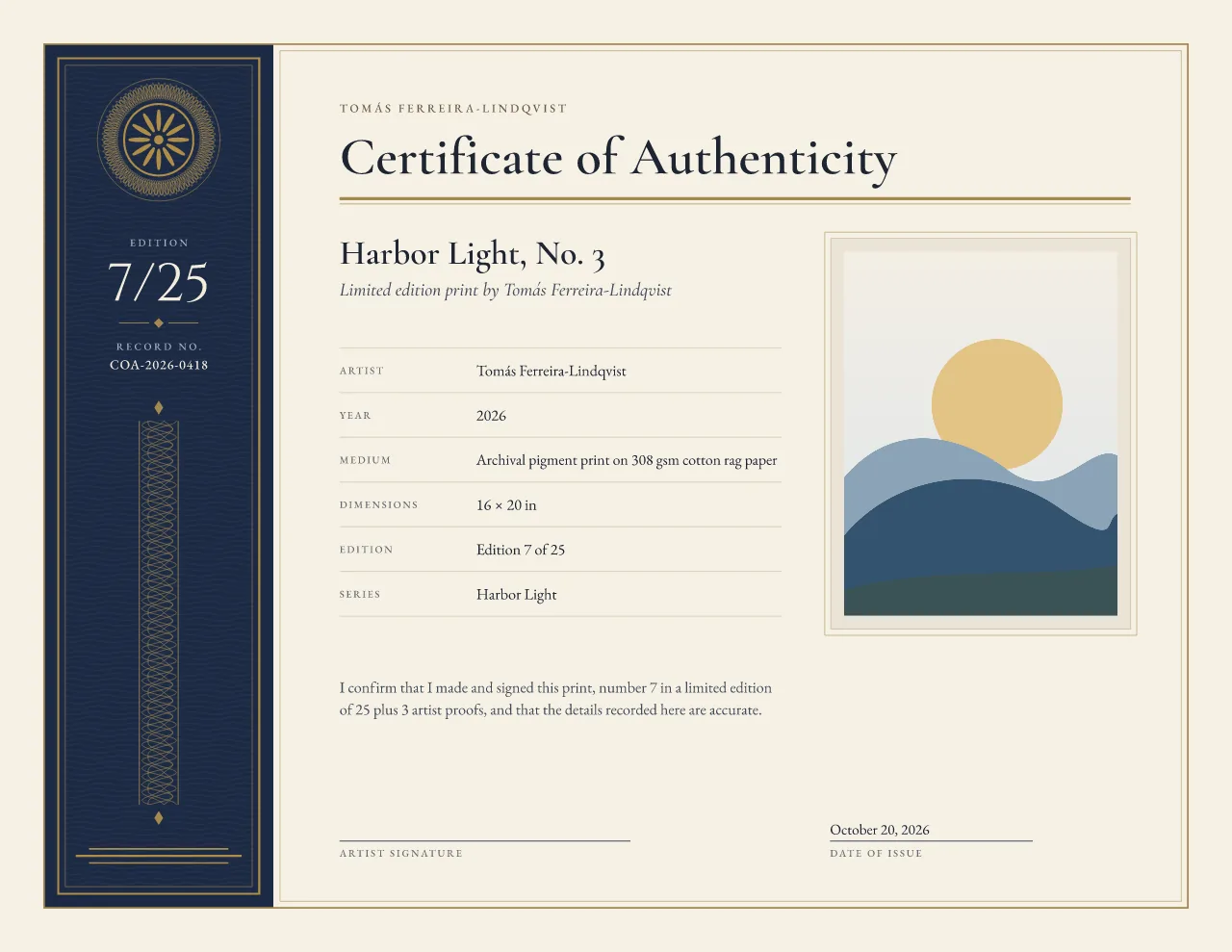
Archive Ledger design
Limited edition print, 7/25
Print 7/25. See edition certificates.
- Issued by
- Tomás Ferreira-Lindqvist
- Work
- Harbor Light, No. 3
- Medium
- Archival pigment print on 308 gsm cotton rag paper
- Size
- 16 × 20 in
- Edition
- Edition 7 of 25
- Certificate no.
- COA-2026-0418
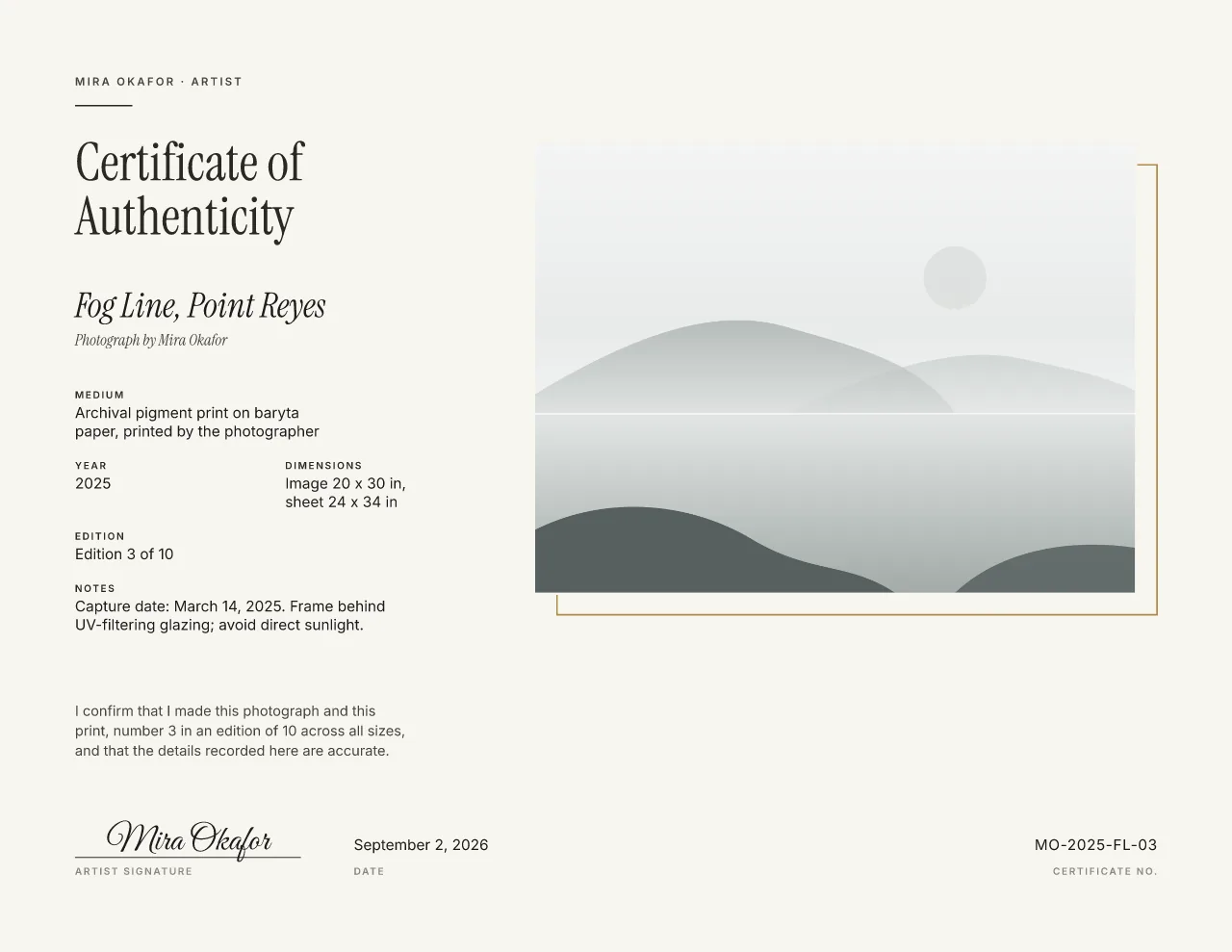
Gallery Minimal design
Fine art photograph, 3/10
Image and sheet size, edition across all sizes. See photography certificates.
- Issued by
- Mira Okafor
- Work
- Fog Line, Point Reyes
- Medium
- Archival pigment print on baryta paper, printed by the photographer
- Size
- Image 20 x 30 in, sheet 24 x 34 in
- Edition
- Edition 3 of 10
- Certificate no.
- MO-2025-FL-03
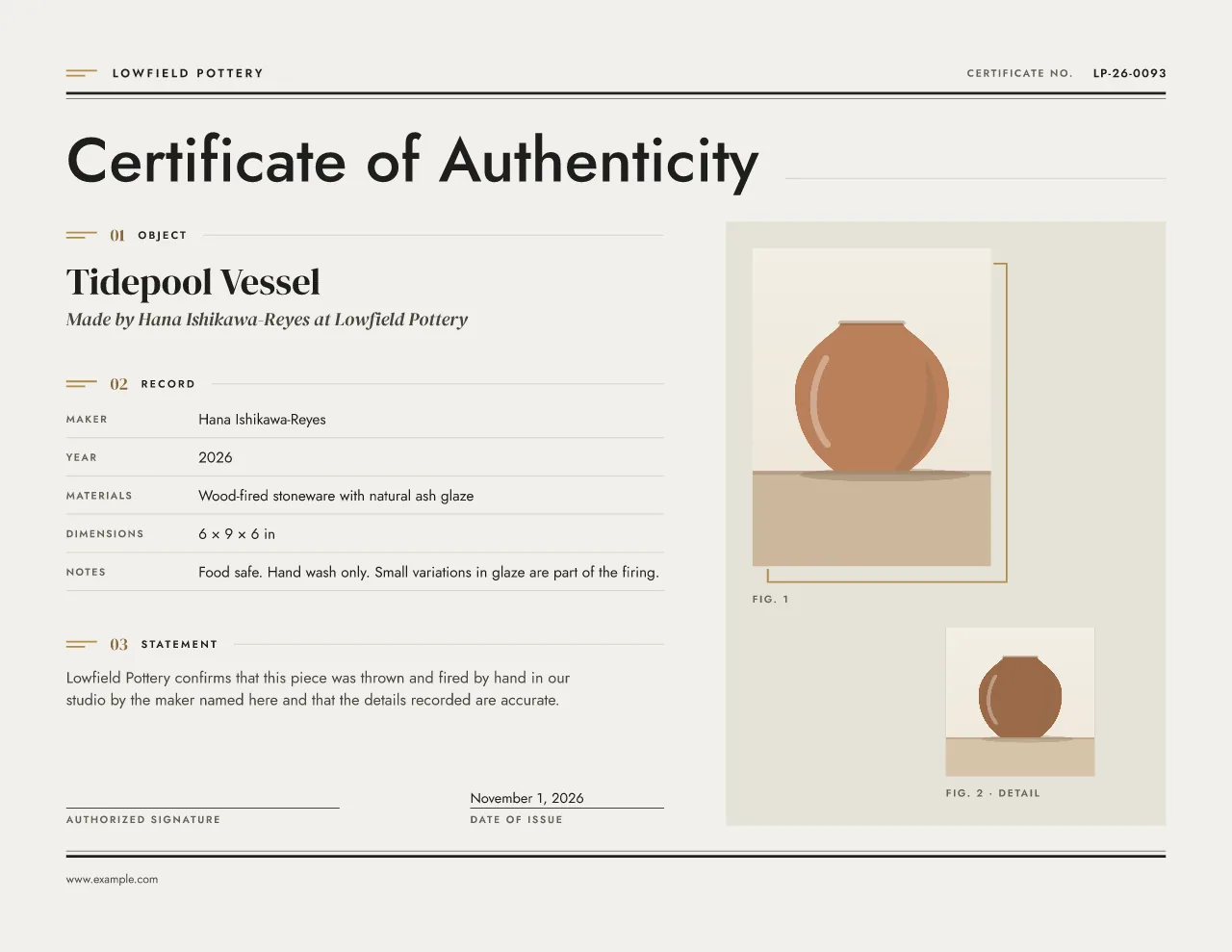
Object Archive design
Handmade ceramic vessel
Studio-issued, with care notes, in the Object Archive design for ceramics and objects.
- Issued by
- Lowfield Pottery
- Work
- Tidepool Vessel
- Medium
- Wood-fired stoneware with natural ash glaze
- Size
- 6 × 9 × 6 in
- Certificate no.
- LP-26-0093
Notice what changes: the photograph gives image and sheet size (“Image 20 x 30 in, sheet 24 x 34 in”), the ceramic piece names both the studio and the maker, and the print carries its edition. For the step-by-step version, see how to make one step by step.
What size to print it
There is no standard size. Choose by where the certificate will live:
- US Letter (8.5 × 11 in) or A4 (210 × 297 mm) for most work: it files with the sale paperwork and fits standard sleeves and frames.
- A5 (148 × 210 mm) to travel with a smaller piece, in packaging or a folder.
- Card-sized certificates are common for jewelry and small objects. We do not offer a card size yet; A5 is the smallest at launch.
Whatever the size, the text must be easy to read and the photo clear. Print at 100% on a heavier matte paper, and keep the PDF.
What a certificate can and cannot prove
A certificate records a statement. It is only as reliable as the person who signs it and the records behind it: a well-known gallery’s certificate, matched to its own archive, carries weight; an unsigned sheet from an unknown seller proves very little.
We make the document, not the judgment