The short answer
An artist proof (AP, or E.A. for épreuve d'artiste) is a print from the same run as a limited edition that the artist keeps outside the numbered edition. It is marked AP, often with its own count such as AP 2/3.
Proofs are usually identical to the numbered prints. They do not count toward the edition total, so an edition of 25 with 3 artist proofs is 28 prints in all, and the certificates should say so.
The term comes from printmaking, where the artist pulled proofs to check the plate before the edition was printed. (Collectible trading cards also use “artist proof” for something unrelated; this guide is about prints.)
How artist proofs are marked
An artist proof is signed like any print in the edition, in pencil below the image, but the edition number is replaced by the proof mark.
- Proof mark where the edition number would go.
- Title, if you use one.
- Signature and year, as on the edition.
| Mark | Name | What it means |
|---|---|---|
| AP, A.P., A/P | Artist proof | Kept by the artist outside the numbered edition. Often numbered among themselves: AP 1/3, AP 2/3. |
| E.A., E/A | Épreuve d’artiste | The French form of artist proof, used the same way. |
| PP | Printer’s proof | Kept by the printer or print studio that produced the edition. |
| HC, H/C | Hors commerce | “Not for trade”: made for exhibition, reference or an archive. |
| BAT | Bon à tirer | “Good to print”: the approved proof the edition is matched against. |
| TP | Trial proof | An early working proof, made while the image or colors were still changing. Often differs from the edition. |
How many artist proofs are normal
There is no rule. A widely used convention is that artist proofs are about 10% of the edition, so 2 or 3 for an edition of 25, and around 10 for an edition of 100. Some artists make none; some publishers allow more.
Numbered edition 25 prints, each marked n/25
Proofs outside the edition, 3 artist proofs
Whatever number you choose, decide it before you sell and state it. “An edition of 25 plus 3 artist proofs” tells a collector exactly how many prints of this image exist.
Printer's proofs, HC and other proofs
Printer’s proofs (PP) go to the printer or studio that produced the edition. HC proofs are made for exhibition or archive, not for sale, though they sometimes reach the market later. The BAT is the single approved proof the printer matches every print against. Trial proofs are working stages and may look quite different from the edition.
All of them sit outside the numbered edition. Record each one the same way: on the print, with its mark; on the certificate, as a proof of the named edition.
Are artist proofs worth more?
Sometimes. There are fewer of them, they are often the prints the artist kept back, and some collectors prefer them. But many sell at the same price as the numbered prints, and the market for an artist, the condition of the print and the size of the edition matter far more than the mark.
Do not promise a higher value on the certificate. Record what the print is, and let the market decide what it is worth.
Writing a certificate for an artist proof
A proof’s certificate looks like the edition’s, with three differences: the edition line reads “Artist's proof 2 of 3” instead of a number, the
statement names the edition the proof belongs to, and it gets its own certificate reference (COA-2026-0446 here,
against COA-2026-0418 for print 7/25).
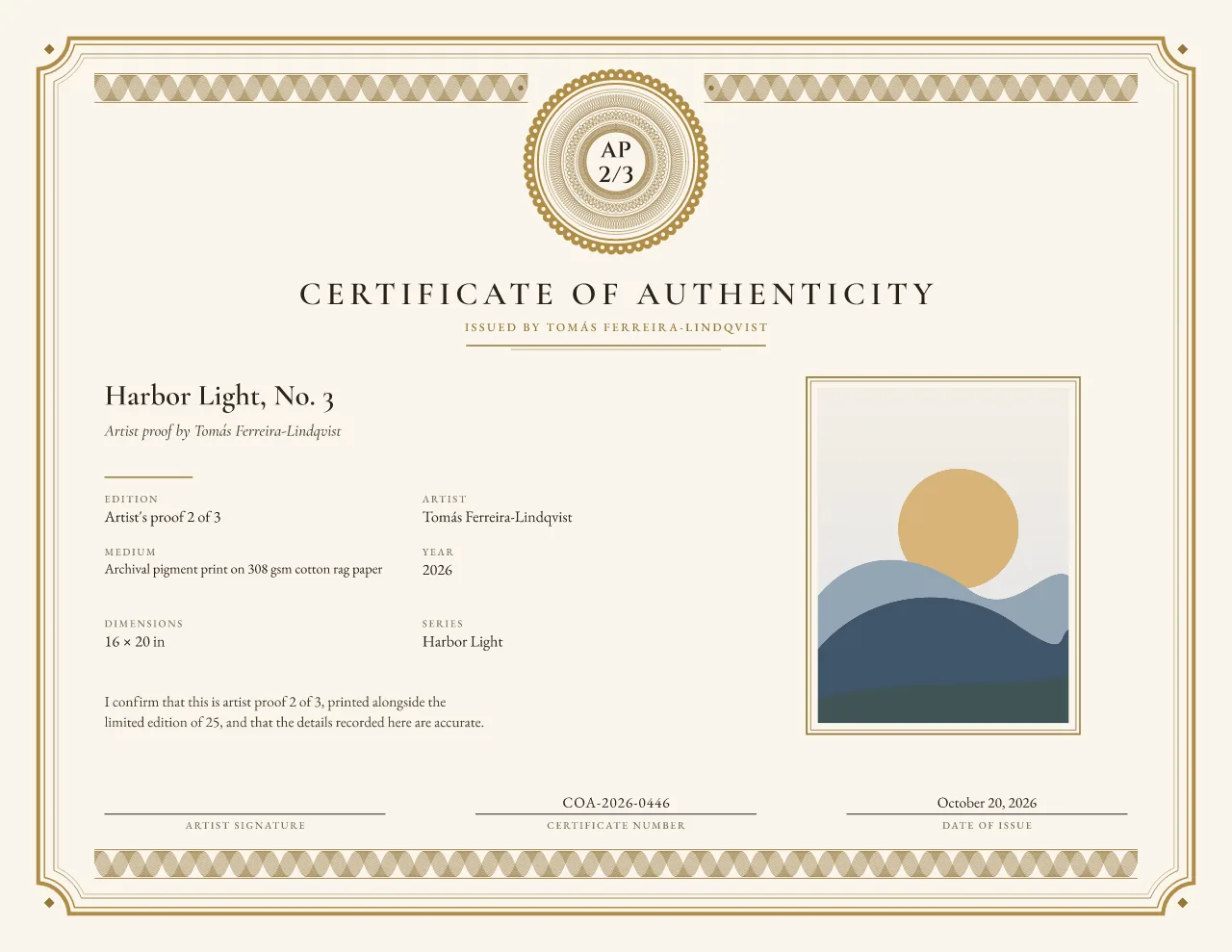
Edition Rosette design
Artist proof, AP 2/3
Same title, medium and size as the edition; the proof is named as a proof.
- Issued by
- Tomás Ferreira-Lindqvist
- Work
- Harbor Light, No. 3
- Medium
- Archival pigment print on 308 gsm cotton rag paper
- Size
- 16 × 20 in
- Edition
- Artist's proof 2 of 3
- Certificate no.
- COA-2026-0446
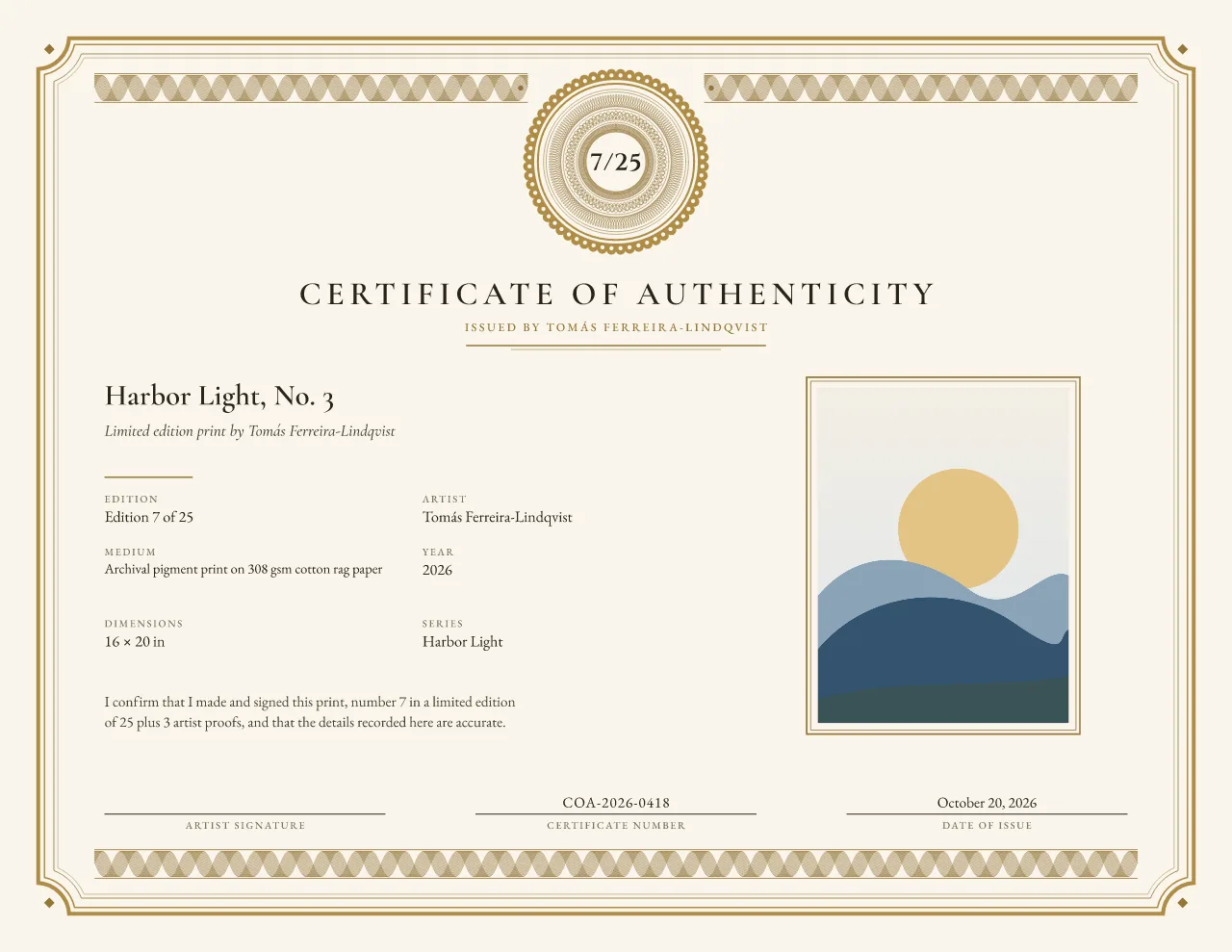
Edition Rosette design
Numbered print, 7/25
The numbered print from the same run, for comparison.
- Issued by
- Tomás Ferreira-Lindqvist
- Work
- Harbor Light, No. 3
- Medium
- Archival pigment print on 308 gsm cotton rag paper
- Size
- 16 × 20 in
- Edition
- Edition 7 of 25
- Certificate no.
- COA-2026-0418
The wording for both is in our guide to wording for an artist proof certificate. When you issue the whole run, make certificates for the edition and its proofs with the same total on every one, or start a single proof certificate in the certificate maker.